
The Explainer
What is a QR memory card, and how does one actually work?
A QR memory card is a printed card that opens a private album of photos, videos, and messages when scanned. Here's how it works, what it costs, and what it replaces.
7 min read
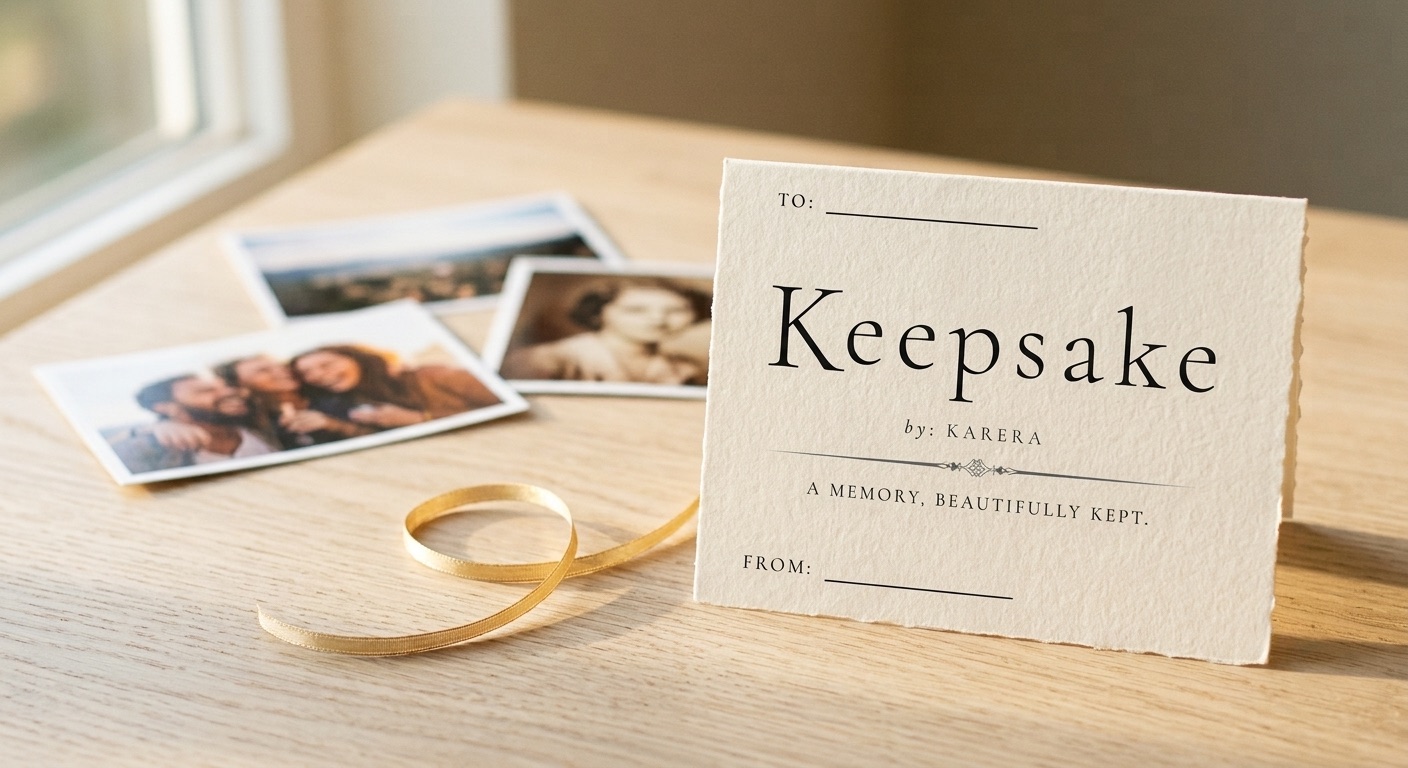
A bouquet lasts nine days. The card that came with it lasts until someone tidies the counter. The memory the gift was meant to mark — the reason any of it was sent — has no object at all.
A QR memory card is an attempt to give that memory somewhere to live. It is a printed card, roughly the size of a business card, with a QR code on it. Scanning the code opens a private album of photos, videos, and messages that the giver assembled before it was sent. No app. No account. A camera and a passcode.
How it works, end to end
There are only two people in the flow — the person giving and the person receiving — and each does one thing.
01
The giver builds the album
Photos, an optional short video, and a written message. On Karera that means up to 30 photos and a video of up to five minutes, dragged straight in from a phone or laptop. The giver chooses a passcode and picks an album style.
02
The card is printed
A QR code is generated for that specific album and printed on the card stock. The card is packed in a mailer box and posted — or handed over with the gift, if it was bought through a florist or boutique.
03
The recipient scans
Any phone camera. No download prompt, no sign-up wall. They enter the passcode the giver shared with them, and the album opens.
04
It stays
The album remains available for two years from activation, is renewable after that, and can be downloaded at any time. A gift with an archive attached.
What is actually on the other side of the code
This is where the category splits. Plenty of QR products point at a video hosted on a public platform, wrapped in recommendations for other people's content. That is a link, not a keepsake.
A memory album is a designed page: the photos in the order the giver chose, a cover image they picked, a message set in type that matches the card, and nothing else competing for attention. No comment field. No view counter. No suggestion that they might also enjoy a video about kitchen renovations.
The absence of an audience is the feature.
The three shapes this takes
One album, one card is the simplest version, but the interesting cases are the ones with more than one contributor.
- Solo — one person builds the album for one recipient. Birthdays, anniversaries, long-distance family, the Mother's Day gift that has to travel.
- Group — up to 10 people each add their own photos, videos, and messages through a shared link, and it all collects behind a single card. This is the one for retirements and office farewells, where the alternative is a card passed desk to desk collecting signatures that say "all the best".
- Event Wall — no card at all. A QR sign sits at an event, guests scan it and leave what they want, and the host shares the finished wall afterward. Weddings, company parties, graduations, celebrations of life.
What it replaces
The Solo and Group Keepsakes both include the printed card, the mailer box, and shipping within Canada, where we currently deliver. An Event Wall is delivered digitally — there is nothing to post, only a sign to print.
The honest comparison is not against other gifts. It is against the greeting card, which costs eight dollars and is thrown out in March. The keepsake is the part of the gift that doesn't get thrown out.
Who this is genuinely wrong for
Two cases. If the recipient has no smartphone, the card cannot be opened, and no amount of good design fixes that. And if you need the printed card in hand within a day, standard post will not cooperate — though rush delivery is same-day in some cities, an Event Wall is immediate, and the album link can be shared straight away while the card follows.
Everything else is a matter of whether the moment deserves an object. Most of them do.
Questions, answered
Karera
Because some moments deserve to stay.
Shop the CollectionKeep reading
Memory Keeping
Your Camera Roll Has 8,000 Photos
We photograph more than any generation in history and give away less of it than ever. On the difference between posting a memory and handing someone one.
The Explainer
Digital Card or Physical Card: Which Should You Send?
Event Wall is digital-only. Solo and Group ship a physical card too. Here's how to decide which one actually fits your occasion.
Delivery
Same-Day & Rush Keepsake Delivery
Karera moves at three speeds: an Event Wall is instant, rush delivery is same-day in select cities, and standard takes about a week. Here's how to pick, and how the album can arrive before the card.
Comments
Loading comments…